Skip to content Skip to footer

ARTHUR SCHNEIDER, M.Ed.

BOARD-LEVEL EXECUTIVE CURRICULUM VITAE

| Academic Technology Executive | Digital Transformation Strategist |

| AI & XR Innovation Leader|

Louisville, Kentucky  USA | XRAcademy.ai | arthur@xracademy.ai

EXECUTIVE LEADERSHIP PROFILE

Academic technology executive and educational innovation leader with more than 50 years of experience guiding institutional transformation through digital learning, enterprise learning ecosystems, faculty enablement, educational technology strategy, and emerging technology innovation across higher education, healthcare, corporate learning, and military training environments.

Recognized for bridging academic priorities with emerging technologies while building sustainable, scalable, and learner-centered environments that improve teaching, learning, and organizational effectiveness. Experienced collaborating with diverse stakeholder groups across academic, corporate, healthcare, and military environments, bringing a global perspective to technology-enabled teaching and learning.

Combines strategic vision, operational leadership, governance, and innovation management with deep expertise in Artificial Intelligence (AI), Extended Reality (XR), immersive learning environments, and future learning ecosystems.

EXECUTIVE VALUE PROPOSITION

• Supported educational technology and digital learning initiatives serving more than 10,000 learners across higher education, healthcare, corporate learning, and military training environments.

• Supported more than 200 faculty members in the adoption of instructional technologies, online learning, hybrid learning, and emerging educational technologies.

• Developed or contributed to more than 100 online, blended, and technology-enhanced learning experiences.

• Consulted with more than 25 organizations regarding instructional design, educational technology strategy, digital learning innovation, organizational learning, and emerging technologies.

• Directed technology planning, acquisition, implementation, and support initiatives across higher education, healthcare, corporate learning, and military training environments.

• Managed technology investments of up to $100,000 per initiative while balancing instructional requirements, scalability, sustainability, and institutional priorities.

• Helped establish the Delphi Learning Center at the University of Louisville, supporting institutional growth in distance education and technology-enhanced learning.

• Contributed to development of the University of Louisville’s first online course, supporting the institution’s early adoption of web-based learning.

• Supported globally distributed learning initiatives serving the United States Army and University of Louisville stakeholders worldwide.

• Led development activities supporting one of the earliest globally deployed online learning initiatives through the University of Louisville–United States Army partnership.

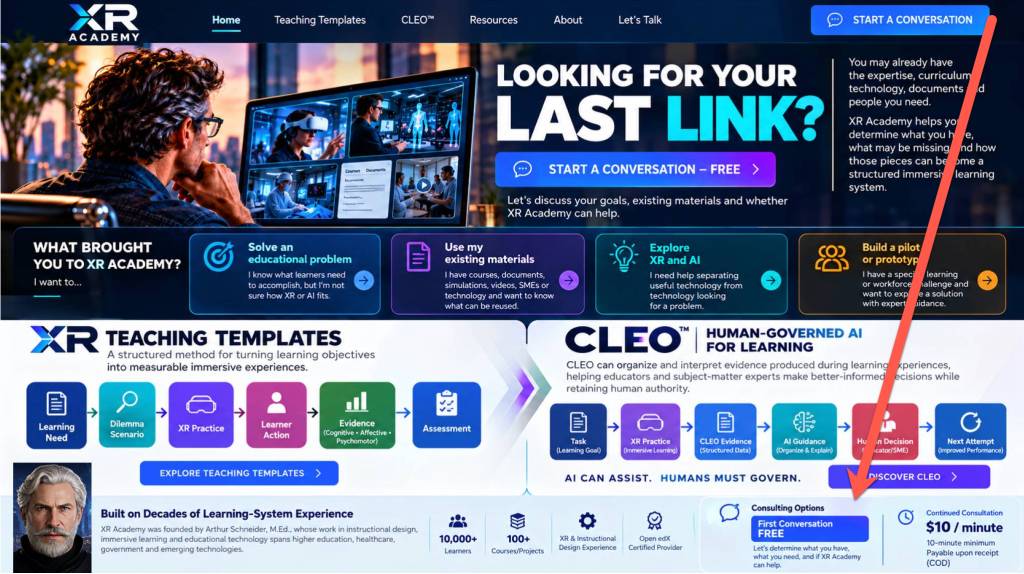
• Founded XRAcademy and developed the XR Teaching Framework.

• Advised institutional leaders on Artificial Intelligence, Extended Reality, digital transformation, immersive learning, and future learning ecosystems.

ACADEMIC TECHNOLOGY GOVERNANCE & OPERATIONAL LEADERSHIP

Provided leadership for the evaluation, acquisition, implementation, and ongoing support of instructional technologies, digital learning platforms, and emerging educational technologies across multiple organizational environments.

Technology Governance & Strategic Planning

• Guided technology selection and implementation decisions through structured needs assessments, gap analyses, stakeholder consultation, and long-term scalability planning.

• Evaluated technology solutions for alignment with institutional goals, instructional requirements, operational sustainability, and industry standards.

Budget Stewardship & Resource Management

• Managed technology investments and implementation initiatives with expenditures of up to $100,000 per project.

• Balanced innovation priorities with fiscal responsibility and long-term operational viability.

Vendor & Partner Management

• Maintained direct working relationships with educational technology, software, hardware, multimedia, and learning platform vendors.

• Evaluated vendor solutions, supported procurement activities, and contributed to technology adoption decisions.

Accessibility & Quality Assurance

• Quality Matters Rubric Certified.

• Advocated for accessible, learner-centered instructional design and continuous improvement of digital learning environments.

• Supported implementation of instructional technologies aligned with accessibility and quality standards.

Change Leadership & Adoption

• Facilitated organizational adoption of instructional technologies through consultation, professional development, stakeholder engagement, and ongoing support.

• Promoted responsible implementation of emerging technologies including Artificial Intelligence and Extended Reality.

EXECUTIVE LEADERSHIP PHILOSOPHY

Technology achieves its greatest value when it advances institutional mission, strengthens teaching and learning, empowers faculty, and improves student success. Throughout my career, I have focused on helping organizations evaluate, implement, and sustain technologies that create measurable educational impact while remaining accessible, scalable, and operationally sustainable.

My leadership approach combines strategic vision with practical execution. I believe successful academic technology initiatives require thoughtful governance, stakeholder engagement, evidence-based decision-making, and a commitment to continuous improvement.

As higher education enters an era shaped by Artificial Intelligence, Extended Reality, immersive learning environments, and data-informed decision-making, I remain committed to helping institutions balance innovation with stewardship, experimentation with accountability, and technological advancement with human-centered learning.

My goal as a leader is to build collaborative learning ecosystems that enable faculty excellence, support learner achievement, foster responsible innovation, and position institutions for long-term success in a rapidly evolving educational landscape.

PROFESSIONAL EXPERIENCE

XRAcademy LLC | Founder & Executive Director | 2021–Present

Lead educational technology research, consulting, and innovation initiatives focused on immersive learning, AI-enhanced learning systems, digital twins, and future learning ecosystems.

Selected Contributions

• Developed the XR Teaching Framework, a research-based model integrating cognitive, affective, and psychomotor assessment methodologies within immersive learning environments.

• Conduct ongoing research involving Artificial Intelligence, Extended Reality, immersive learning design, digital twins, experiential learning, and educational assessment.

• Provide strategic consulting, professional development, and innovation guidance to educational organizations exploring Artificial Intelligence, Extended Reality, immersive learning environments, and future learning ecosystems.

• Advise educational leaders and organizations regarding innovation strategy, digital transformation, technology adoption, and future learning ecosystems.

• Evaluate emerging technologies and translate innovation into sustainable educational practice.

University of Louisville | Research & Development Programmer | 1996–2002

Provided leadership for technology planning, implementation, and support activities that advanced institutional online learning, distance education, and educational technology initiatives.

Selected Contributions

• Helped establish the Delphi Learning Center, supporting the University’s expansion of distance education and technology-enhanced learning initiatives.

• Contributed to development of the University of Louisville’s first online course, supporting early adoption of web-based instructional delivery.

• Directed technology planning and implementation activities supporting large-scale distance-learning initiatives.

• Collaborated with military leadership, university administrators, faculty, instructional developers, and technical specialists to establish scalable educational technology services supporting geographically distributed learners.

• Supported one of the earliest globally deployed online learning initiatives developed through a partnership between the University of Louisville and the United States Army.

• Served as lead developer for the University’s initial online presence, helping establish foundational web-based communication and learning capabilities.

• Supervised instructional development and technical personnel responsible for educational technology implementation, multimedia production, and online learning support.

• Evaluated emerging technologies and contributed to institutional technology adoption decisions.

• Contributed to foundational online learning infrastructure during a formative period in the evolution of web-based education.


Pearson Learning Solutions | Senior Instructional Designer | 2009–2014

• Led development of enterprise-scale instructional and e-learning solutions serving diverse educational audiences.

Rutgers University | Instructional Design Specialist | 2014–2016

• Supported faculty development initiatives, instructional technology implementation, online learning development, and curriculum modernization.

Mayo Clinic | Instructional Design Specialist (Supplemental) | 2019–2021

• Developed online learning resources supporting healthcare education and professional development initiatives.

E-Learning Insights / E-Learning Engine

• Provided consulting services focused on instructional design, educational technology strategy, organizational learning, and digital learning innovation.

AI, XR & EMERGING TECHNOLOGY LEADERSHIP

Creator of the XR Teaching Framework.

Research and professional focus includes:

• Artificial Intelligence in Education
• Extended Reality (XR)
• Virtual Reality (VR)
• Augmented Reality (AR)
• Mixed Reality (MR)
• Digital Analytics
• Experiential Learning
• Educational Assessment
• Future Learning Ecosystems

MEDIA PRODUCTION, LEARNING ENVIRONMENTS & DIGITAL ECOSYSTEMS

Experience supporting multimedia production, online learning development, instructional media integration, classroom technology evaluation, and digital learning ecosystems.

Served as lead developer for the University of Louisville’s initial online presence and collaborated extensively with instructional designers, developers, media specialists, and technical professionals to create engaging technology-enhanced learning experiences.

EDUCATION & CREDENTIALS

MIT Professional Education
Professional Certificate in Virtual Reality and Augmented Reality

University of Louisville
Master of Education (M.Ed.), Occupational Training and Development

Indiana University
Bachelor of Science, Education

Quality Matters Rubric Certification

HONORS & PROFESSIONAL AFFILIATIONS

• Marquis Who’s Who in the World
• Marquis Who’s Who in Science and Engineering
• Phi Kappa Phi National Honor Society
• Association for Computing Machinery (ACM)
• National Computer Graphics Association

EXECUTIVE DIFFERENTIATOR

Combines pioneering experience in online learning, enterprise academic technology leadership, faculty enablement, and emerging technology innovation with a demonstrated ability to translate Artificial Intelligence, Extended Reality, and digital learning strategies into sustainable institutional capabilities that advance teaching, learning, and student success.

Brings a rare combination of historical perspective, operational leadership, educational innovation expertise, and future-focused vision developed through more than fifty decades of leadership across higher education, healthcare, corporate learning, and military training environments.


VR Therapy: The New Frontier in Mental Health and Wellness

Exploring the Potential of VR in Mental Health

A Groundbreaking Approach to Therapy

Virtual Reality (VR) therapy is not just a new tool in the mental health toolkit; it represents a paradigm shift in treatment approaches. By immersing patients in carefully constructed virtual environments, VR therapy bridges the gap between the therapist’s office and the real-world scenarios where mental health challenges arise. This technology allows for a level of control and safety not typically available in traditional therapy settings, providing a unique platform for exposure, understanding, and healing.

The Science Behind VR Therapy

At its core, VR therapy is about merging psychological principles with immersive technology. This fusion creates a powerful therapeutic environment where mental health professionals can simulate scenarios relevant to a patient’s condition. These controlled settings are ideal for practicing coping strategies and confronting fears, under the guidance of a therapist. It’s an innovative approach that combines the safety of a therapist’s office with the realism needed for effective treatment.

VR Therapy in Action: Case Studies and Success Stories

Addressing Phobias and Anxiety

One of the most compelling applications of VR therapy is in the treatment of phobias and anxiety disorders. Patients with a fear of heights, flying, or public speaking, for instance, can confront these fears in a virtual yet safe environment. This gradual exposure helps them build confidence and reduce anxiety levels over time.

Enhancing Traditional Therapies

VR therapy is not about replacing traditional methods but augmenting them. When combined with cognitive-behavioral therapy (CBT) and other established approaches, VR adds a new dimension that can deepen the therapeutic experience. This integration offers a more holistic treatment approach, catering to various learning styles and patient needs.

The Advantages of VR Therapy

Creating a Controlled Healing Environment:

The controlled environment of VR therapy is one of its greatest strengths. Patients can experience scenarios that are difficult or impossible to replicate in real life, providing valuable opportunities for therapy and personal growth.

Customizable and Diverse Therapeutic Applications:

VR therapy is not a one-size-fits-all solution. Each session can be tailored to the individual’s specific needs, making it an adaptable tool for a wide array of psychological conditions, from PTSD to depression.

Challenges and Ethical Considerations

Navigating New Territory in Mental Health:

As VR therapy is relatively new, it brings its set of challenges, including understanding its long-term effects and ensuring ethical practices. Ensuring that these virtual experiences are used responsibly and effectively in a therapeutic context is crucial.

Ensuring Broad Accessibility:

Another significant challenge is accessibility. Making VR therapy available to a diverse range of patients, regardless of their socio-economic background, is essential for its broader adoption and effectiveness.

Looking Ahead: The Future of VR in Mental Health

Broadening the Scope of Treatment:

The future of VR therapy is incredibly promising. Ongoing research is exploring its applications for a broader range of mental health conditions, continually pushing the boundaries of how we approach mental wellness.

Empowering Patients in Their Mental Health Journey:

More than just a therapeutic tool, VR therapy is about empowering patients, giving them an active role in their treatment and recovery process. It offers a new way for individuals to engage with their mental health, potentially transforming the therapeutic landscape.

Conclusion

Embracing a New Era in Mental Health Care. The integration of VR into mental health care is more than an innovation; it’s a revolution in how we approach treatment and recovery. As this technology continues to evolve and become more integrated into healthcare systems, it holds the promise of transforming lives and opening new pathways to mental wellness.

Leave a comment