Skip to content Skip to footer

AI ASSISTS . . . HUMANS MUST GOVERN

                                             ARTHUR SCHNEIDER, M.Ed.

                              BOARD-LEVEL EXECUTIVE CURRICULUM VITAE

Academic Technology Executive | Digital Transformation Strategist /                                                            |AI & XR Innovation Leader

                  Louisville, Kentucky USA | XRAcademy.ai | arthur@xracademy.ai

EXECUTIVE LEADERSHIP PROFILE

Academic technology executive and educational innovation leader with more than 50 years of experience guiding institutional transformation through digital learning, enterprise learning ecosystems, faculty enablement, educational technology strategy, and emerging technology innovation across higher education, healthcare, corporate learning, and military training environments.

Recognized for bridging academic priorities with emerging technologies while building sustainable, scalable, and learner-centered environments that improve teaching, learning, and organizational effectiveness. Experienced collaborating with diverse stakeholder groups across academic, corporate, healthcare, and military environments, bringing a global perspective to technology-enabled teaching and learning.

Combines strategic vision, operational leadership, governance, and innovation management with deep expertise in Artificial Intelligence (AI), Extended Reality (XR), immersive learning environments, and future learning ecosystems.

EXECUTIVE VALUE PROPOSITION

  • Supported educational technology and digital learning initiatives serving more than 10,000 learners across higher education, healthcare, corporate learning, and military training environments.
  • Supported more than 200 faculty members in the adoption of instructional technologies, online learning, hybrid learning, and emerging educational technologies.
  • Developed or contributed to more than 100 online, blended, and technology-enhanced learning experiences.
  • Consulted with more than 25 organizations regarding instructional design, educational technology strategy, digital learning innovation, organizational learning, and emerging technologies.
  • Directed technology planning, acquisition, implementation, and support initiatives across higher education, healthcare, corporate learning, and military training environments.
  • Managed technology investments of up to $100,000 per initiative while balancing instructional requirements, scalability, sustainability, and institutional priorities.
  • Helped establish the Delphi Learning Center at the University of Louisville, supporting institutional growth in distance education and technology-enhanced learning.
  • Contributed to development of the University of Louisville’s first online course, supporting the institution’s early adoption of web-based learning.
  • Supported globally distributed learning initiatives serving the United States Army and University of Louisville stakeholders worldwide.
  • Led development activities supporting one of the earliest globally deployed online learning initiatives through the University of Louisville–United States Army partnership.
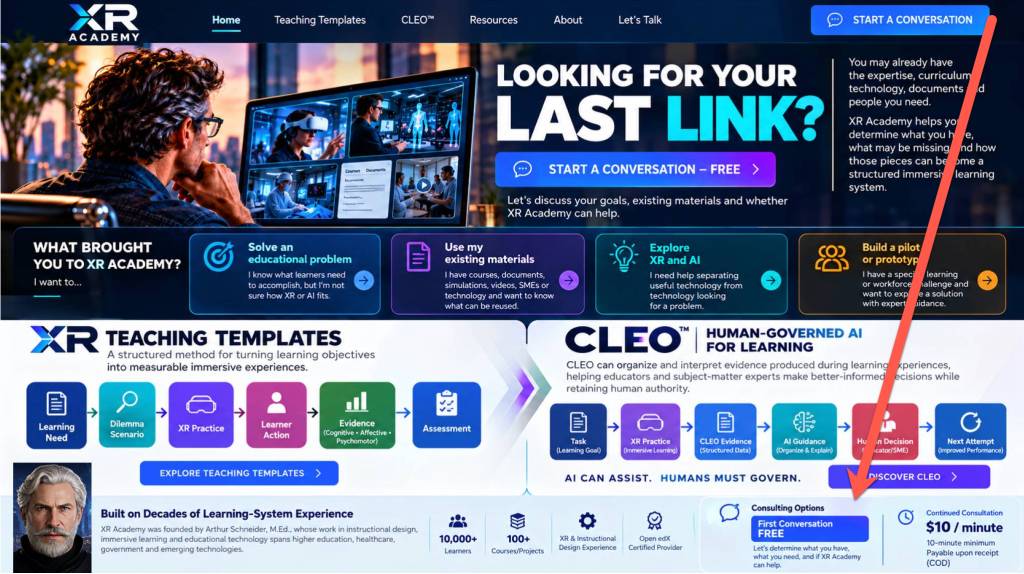
  • Founded XRAcademy and developed the XR Teaching Framework.
  • Advised institutional leaders on Artificial Intelligence, Extended Reality, digital transformation, immersive learning, and future learning ecosystems.

ACADEMIC TECHNOLOGY GOVERNANCE & OPERATIONAL LEADERSHIP

Provided leadership for the evaluation, acquisition, implementation, and ongoing support of instructional technologies, digital learning platforms, and emerging educational technologies across multiple organizational environments.

Technology Governance & Strategic Planning

  • Guided technology selection and implementation decisions through structured needs assessments, gap analyses, stakeholder consultation, and long-term scalability planning.
  • Evaluated technology solutions for alignment with institutional goals, instructional requirements, operational sustainability, and industry standards.

Budget Stewardship & Resource Management

  • Managed technology investments and implementation initiatives with expenditures of up to $100,000 per project.
  • Balanced innovation priorities with fiscal responsibility and long-term operational viability.

Vendor & Partner Management

  • Maintained direct working relationships with educational technology, software, hardware, multimedia, and learning platform vendors.
  • Evaluated vendor solutions, supported procurement activities, and contributed to technology adoption decisions.

Accessibility & Quality Assurance

  • Quality Matters Rubric Certified.
  • Advocated for accessible, learner-centered instructional design and continuous improvement of digital learning environments.
  • Supported implementation of instructional technologies aligned with accessibility and quality standards.

Change Leadership & Adoption

  • Facilitated organizational adoption of instructional technologies through consultation, professional development, stakeholder engagement, and ongoing support.
  • Promoted responsible implementation of emerging technologies including Artificial Intelligence and Extended Reality.

EXECUTIVE LEADERSHIP PHILOSOPHY

Technology achieves its greatest value when it advances institutional mission, strengthens teaching and learning, empowers faculty, and improves student success. Throughout my career, I have focused on helping organizations evaluate, implement, and sustain technologies that create measurable educational impact while remaining accessible, scalable, and operationally sustainable.

My leadership approach combines strategic vision with practical execution. I believe successful academic technology initiatives require thoughtful governance, stakeholder engagement, evidence-based decision-making, and a commitment to continuous improvement.

As higher education enters an era shaped by Artificial Intelligence, Extended Reality, immersive learning environments, and data-informed decision-making, I remain committed to helping institutions balance innovation with stewardship, experimentation with accountability, and technological advancement with human-centered learning.

My goal as a leader is to build collaborative learning ecosystems that enable faculty excellence, support learner achievement, foster responsible innovation, and position institutions for long-term success in a rapidly evolving educational landscape.

PROFESSIONAL EXPERIENCE

XRAcademy LLC | Founder & Executive Director | 2021–Present

Lead educational technology research, consulting, and innovation initiatives focused on immersive learning, AI-enhanced learning systems, digital twins, and future learning ecosystems.

Selected Contributions

  • Developed the XR Teaching Framework, a research-based model integrating cognitive, affective, and psychomotor assessment methodologies within immersive learning environments.
  • Conduct ongoing research involving Artificial Intelligence, Extended Reality, immersive learning design, digital twins, experiential learning, and educational assessment.
  • Provide strategic consulting, professional development, and innovation guidance to educational organizations exploring Artificial Intelligence, Extended Reality, immersive learning environments, and future learning ecosystems.
  • Advise educational leaders and organizations regarding innovation strategy, digital transformation, technology adoption, and future learning ecosystems.
  • Evaluate emerging technologies and translate innovation into sustainable educational practice.

University of Louisville | Research & Development Programmer | 1996–2002

Provided leadership for technology planning, implementation, and support activities that advanced institutional online learning, distance education, and educational technology initiatives.

Selected Contributions

  • Helped establish the Delphi Learning Center, supporting the University’s expansion of distance education and technology-enhanced learning initiatives.
  • Contributed to development of the University of Louisville’s first online course, supporting early adoption of web-based instructional delivery.
  • Directed technology planning and implementation activities supporting large-scale distance-learning initiatives.
  • Collaborated with military leadership, university administrators, faculty, instructional developers, and technical specialists to establish scalable educational technology services supporting geographically distributed learners.
  • Supported one of the earliest globally deployed online learning initiatives developed through a partnership between the University of Louisville and the United States Army.
  • Served as lead developer for the University’s initial online presence, helping establish foundational web-based communication and learning capabilities.
  • Supervised instructional development and technical personnel responsible for educational technology implementation, multimedia production, and online learning support.
  • Evaluated emerging technologies and contributed to institutional technology adoption decisions.
  • Contributed to foundational online learning infrastructure during a formative period in the evolution of web-based education.

Pearson Learning Solutions | Senior Instructional Designer | 2009–2014

  • Led development of enterprise-scale instructional and e-learning solutions serving diverse educational audiences.

Rutgers University | Instructional Design Specialist | 2014–2016

  • Supported faculty development initiatives, instructional technology implementation, online learning development, and curriculum modernization.

Mayo Clinic | Instructional Design Specialist (Supplemental) | 2019–2021

  • Developed online learning resources supporting healthcare education and professional development initiatives.

E-Learning Insights / E-Learning Engine | 2021–2024

  • Provided consulting services focused on instructional design, educational technology strategy, organizational learning, and digital learning innovation.

AI, XR & EMERGING TECHNOLOGY LEADERSHIP

Creator of the XR Teaching Framework.

Research and professional focus includes:

  • Artificial Intelligence in Education
    • Extended Reality (XR)
    • Virtual Reality (VR)
    • Augmented Reality (AR)
    • Mixed Reality (MR)
    • Digital Analytics
    • Experiential Learning
    • Educational Assessment
    • Future Learning Ecosystems

MEDIA PRODUCTION, LEARNING ENVIRONMENTS & DIGITAL ECOSYSTEMS

Experience supporting multimedia production, online learning development, instructional media integration, classroom technology evaluation, and digital learning ecosystems.

Served as lead developer for the University of Louisville’s initial online presence and collaborated extensively with instructional designers, developers, media specialists, and technical professionals to create engaging technology-enhanced learning experiences.

EDUCATION & CREDENTIALS

MIT Professional Education
Professional Certificate in Virtual Reality and Augmented Reality

University of Louisville
Master of Education (M.Ed.), Occupational Training and Development

Indiana University
Bachelor of Science, Education

Quality Matters Rubric Certification

HONORS & PROFESSIONAL AFFILIATIONS

  • Marquis Who’s Who in the World
    • Marquis Who’s Who in Science and Engineering
    • Phi Kappa Phi National Honor Society
    • Association for Computing Machinery (ACM)
    • National Computer Graphics Association

EXECUTIVE DIFFERENTIATOR

Combines pioneering experience in online learning, enterprise academic technology leadership, faculty enablement, and emerging technology innovation with a demonstrated ability to translate Artificial Intelligence, Extended Reality, and digital learning strategies into sustainable institutional capabilities that advance teaching, learning, and student success.

Brings a rare combination of historical perspective, operational leadership, educational innovation expertise, and future-focused vision developed through more than fifty decades of leadership across higher education, healthcare, corporate learning, and military training environments. 

Unlocking the Metaverse: A Revolution in the Making

In recent times, the concept of the metaverse has captured the imagination of the tech world, sparking intriguing discussions about its potential to reshape our digital landscape. Although it remains in its early stages, the metaverse has clearly demonstrated that it is more than just a fleeting trend. This blog sets out to explore the metaverse’s fundamental capabilities, highlighting its significant promise for businesses, content creators, and consumers. Through real-world examples, data-driven insights, and market projections, we aim to unveil the metaverse’s vast potential.

Driving Forces Behind Metaverse Adoption

  1. Interoperability and Standards: A notable criticism of the metaverse has been its fragmented nature, with virtual worlds operating in isolation. However, efforts like the Metaverse Standards Forum, comprising influential tech leaders, are striving to establish open standards. These standards are poised to facilitate seamless interactions, allowing avatars, digital assets, and payments to traverse across diverse virtual realms.
  2. Rapid User Adoption: The numbers speak volumes about metaverse adoption. Platforms such as Meta Horizon and Decentraland have witnessed explosive growth, amassing millions of active users. This surge is further exemplified by record-breaking virtual real estate transactions and NFT sales. The increasing expansiveness and immersion of virtual worlds indicate an upward trajectory in user adoption.
  3. Corporate Embrace: The metaverse is gaining substantial interest from major corporations, signaling a recognition of long-term value rather than a fleeting trend. In the years 2022 and early 2023, corporations have already invested over $150 billion in the metaverse and its related technologies. Tech giants, including Microsoft, Meta, Apple, and Google, along with renowned brands such as Nike, Walmart, Disney, and JP Morgan, are establishing robust metaverse footholds to engage the next generation of consumers and explore new revenue avenues.
  4. Empowering the Creator Economy: One of the metaverse’s most compelling features is its democratization of monetization. It offers individual creators a platform to thrive, enabling them to build virtual businesses and capitalize on virtual real estate, digital fashion design, NFT art sales, and more. In 2022, a staggering 50,000 active creators collectively earned $500 million on Meta Horizon platforms alone. The World Economic Forum anticipates the creation of 10 million new metaverse jobs catering to creators of diverse talents within the next decade.
  5. Advancements in Immersive Realism: Although not without imperfections, some metaverse environments are already showcasing remarkable levels of immersion and realism. For instance, Nvidia’s Omniverse platform features lifelike human avatars that seamlessly interact with real-world physics. Tech giants are channeling billions into improving graphics, artificial intelligence, augmented reality, haptic feedback, and more, with the ultimate goal of enhancing realism. As these technologies mature, the boundary between the virtual and physical worlds will blur, further accelerating mass adoption.

Practical Applications Demonstrating Tangible Benefits

  1. Training and Simulation: The metaverse introduces a new dimension of training through complete immersion. For instance, Walmart utilizes VR-based training to prepare employees for new roles, enhancing confidence and knowledge retention. Complex training scenarios, such as flight simulation, which entail substantial costs and risks in the physical world, can be conducted affordably and safely in virtual reality. These applications underscore the metaverse’s ability to compress time, space, and resources.
  2. Virtual Events and Collaborations: The metaverse has facilitated rapid growth in virtual events, particularly during the pandemic. In 2022, over 2,000 virtual events took place on platforms like 6V360 and Decentraland. Early indicators for 2023 suggest that this trend is on an upward trajectory, with over 500 virtual events hosted in Q1 2023 alone. The metaverse’s capacity to connect remote audiences has transformed the landscape of virtual conferences, concerts, and other gatherings. Moreover, its suitability for international collaboration in virtual office spaces is revolutionizing business operations.
  3. Digital Products and Services: Leading brands like Nike and Balenciaga have harnessed the metaverse’s potential by generating substantial revenues from digital fashion and accessories tailored for avatars. This emerging market reveals a novel revenue stream—a range of virtual products imbued with real value, devoid of physical production costs. Beyond fashion, the metaverse opens doors to delivering a myriad of services such as healthcare, counseling, tutoring, and more in a virtual context.

Envisioning the Future of the Metaverse

The metaverse is currently in its infancy, with significant technological advancements poised to shape its trajectory:

  • The convergence of augmented reality (AR) and virtual reality (VR) technologies, fostering a seamless blend of virtual and physical realms, enriched by improved graphics and heightened realism.
  • Widespread adoption of wearables, including AR glasses, VR headsets, and haptic gloves/suits, to facilitate frictionless interactions within the metaverse.
  • The growth of the Internet of Things (IoT) and the development of smart cities, connecting physical infrastructure and spaces with virtual environments.
  • The emergence of diverse metaverse platforms across various industries, including healthcare, education, real estate, and manufacturing.
  • The amalgamation of digital identities, cryptocurrencies, NFTs, and decentralized finance within the metaverse’s intricate tapestry.
  • The integration of advanced AI capabilities, such as digital assistants, intelligent NPCs (non-playable characters), and predictive analytics, enhancing the metaverse’s functionality.
  • The maturation of governance models and regulatory frameworks as virtual economies burgeon in scale and complexity.
  • The continued evolution of user-generated content (UGC) and features for creator monetization, fostering entrepreneurial opportunities.

In conclusion, dismissing the metaverse as mere hype would be a grave oversight. By examining usage metrics, corporate investments, technological strides, and practical applications, it becomes evident that the metaverse represents a paradigm shift that is poised to deliver on its potential. The question is no longer whether the metaverse will become mainstream, but rather how and when its widespread integration will reshape our work, play, creativity, and connections. It is abundantly clear that the metaverse is far more than a fleeting trend; its transformative impact on businesses and society will continue to expand and evolve. Exciting times lie ahead as we embark on this remarkable journey.

Leave a comment