Skip to content Skip to footer

ARTHUR SCHNEIDER, M.Ed.

BOARD-LEVEL EXECUTIVE CURRICULUM VITAE

| Academic Technology Executive | Digital Transformation Strategist |

| AI & XR Innovation Leader|

Louisville, Kentucky  USA | XRAcademy.ai | arthur@xracademy.ai

EXECUTIVE LEADERSHIP PROFILE

Academic technology executive and educational innovation leader with more than 50 years of experience guiding institutional transformation through digital learning, enterprise learning ecosystems, faculty enablement, educational technology strategy, and emerging technology innovation across higher education, healthcare, corporate learning, and military training environments.

Recognized for bridging academic priorities with emerging technologies while building sustainable, scalable, and learner-centered environments that improve teaching, learning, and organizational effectiveness. Experienced collaborating with diverse stakeholder groups across academic, corporate, healthcare, and military environments, bringing a global perspective to technology-enabled teaching and learning.

Combines strategic vision, operational leadership, governance, and innovation management with deep expertise in Artificial Intelligence (AI), Extended Reality (XR), immersive learning environments, and future learning ecosystems.

EXECUTIVE VALUE PROPOSITION

• Supported educational technology and digital learning initiatives serving more than 10,000 learners across higher education, healthcare, corporate learning, and military training environments.

• Supported more than 200 faculty members in the adoption of instructional technologies, online learning, hybrid learning, and emerging educational technologies.

• Developed or contributed to more than 100 online, blended, and technology-enhanced learning experiences.

• Consulted with more than 25 organizations regarding instructional design, educational technology strategy, digital learning innovation, organizational learning, and emerging technologies.

• Directed technology planning, acquisition, implementation, and support initiatives across higher education, healthcare, corporate learning, and military training environments.

• Managed technology investments of up to $100,000 per initiative while balancing instructional requirements, scalability, sustainability, and institutional priorities.

• Helped establish the Delphi Learning Center at the University of Louisville, supporting institutional growth in distance education and technology-enhanced learning.

• Contributed to development of the University of Louisville’s first online course, supporting the institution’s early adoption of web-based learning.

• Supported globally distributed learning initiatives serving the United States Army and University of Louisville stakeholders worldwide.

• Led development activities supporting one of the earliest globally deployed online learning initiatives through the University of Louisville–United States Army partnership.

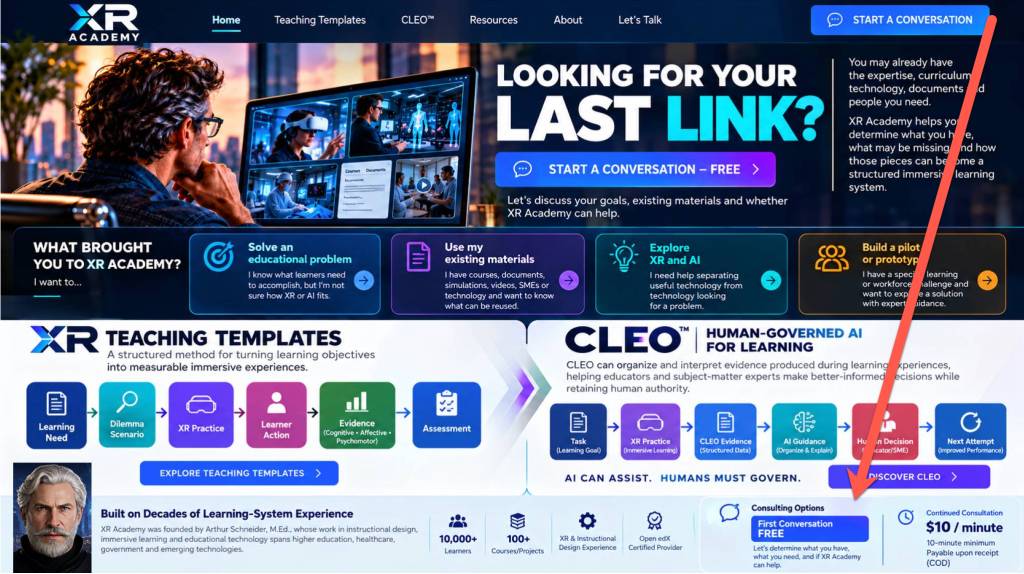
• Founded XRAcademy and developed the XR Teaching Framework.

• Advised institutional leaders on Artificial Intelligence, Extended Reality, digital transformation, immersive learning, and future learning ecosystems.

ACADEMIC TECHNOLOGY GOVERNANCE & OPERATIONAL LEADERSHIP

Provided leadership for the evaluation, acquisition, implementation, and ongoing support of instructional technologies, digital learning platforms, and emerging educational technologies across multiple organizational environments.

Technology Governance & Strategic Planning

• Guided technology selection and implementation decisions through structured needs assessments, gap analyses, stakeholder consultation, and long-term scalability planning.

• Evaluated technology solutions for alignment with institutional goals, instructional requirements, operational sustainability, and industry standards.

Budget Stewardship & Resource Management

• Managed technology investments and implementation initiatives with expenditures of up to $100,000 per project.

• Balanced innovation priorities with fiscal responsibility and long-term operational viability.

Vendor & Partner Management

• Maintained direct working relationships with educational technology, software, hardware, multimedia, and learning platform vendors.

• Evaluated vendor solutions, supported procurement activities, and contributed to technology adoption decisions.

Accessibility & Quality Assurance

• Quality Matters Rubric Certified.

• Advocated for accessible, learner-centered instructional design and continuous improvement of digital learning environments.

• Supported implementation of instructional technologies aligned with accessibility and quality standards.

Change Leadership & Adoption

• Facilitated organizational adoption of instructional technologies through consultation, professional development, stakeholder engagement, and ongoing support.

• Promoted responsible implementation of emerging technologies including Artificial Intelligence and Extended Reality.

EXECUTIVE LEADERSHIP PHILOSOPHY

Technology achieves its greatest value when it advances institutional mission, strengthens teaching and learning, empowers faculty, and improves student success. Throughout my career, I have focused on helping organizations evaluate, implement, and sustain technologies that create measurable educational impact while remaining accessible, scalable, and operationally sustainable.

My leadership approach combines strategic vision with practical execution. I believe successful academic technology initiatives require thoughtful governance, stakeholder engagement, evidence-based decision-making, and a commitment to continuous improvement.

As higher education enters an era shaped by Artificial Intelligence, Extended Reality, immersive learning environments, and data-informed decision-making, I remain committed to helping institutions balance innovation with stewardship, experimentation with accountability, and technological advancement with human-centered learning.

My goal as a leader is to build collaborative learning ecosystems that enable faculty excellence, support learner achievement, foster responsible innovation, and position institutions for long-term success in a rapidly evolving educational landscape.

PROFESSIONAL EXPERIENCE

XRAcademy LLC | Founder & Executive Director | 2021–Present

Lead educational technology research, consulting, and innovation initiatives focused on immersive learning, AI-enhanced learning systems, digital twins, and future learning ecosystems.

Selected Contributions

• Developed the XR Teaching Framework, a research-based model integrating cognitive, affective, and psychomotor assessment methodologies within immersive learning environments.

• Conduct ongoing research involving Artificial Intelligence, Extended Reality, immersive learning design, digital twins, experiential learning, and educational assessment.

• Provide strategic consulting, professional development, and innovation guidance to educational organizations exploring Artificial Intelligence, Extended Reality, immersive learning environments, and future learning ecosystems.

• Advise educational leaders and organizations regarding innovation strategy, digital transformation, technology adoption, and future learning ecosystems.

• Evaluate emerging technologies and translate innovation into sustainable educational practice.

University of Louisville | Research & Development Programmer | 1996–2002

Provided leadership for technology planning, implementation, and support activities that advanced institutional online learning, distance education, and educational technology initiatives.

Selected Contributions

• Helped establish the Delphi Learning Center, supporting the University’s expansion of distance education and technology-enhanced learning initiatives.

• Contributed to development of the University of Louisville’s first online course, supporting early adoption of web-based instructional delivery.

• Directed technology planning and implementation activities supporting large-scale distance-learning initiatives.

• Collaborated with military leadership, university administrators, faculty, instructional developers, and technical specialists to establish scalable educational technology services supporting geographically distributed learners.

• Supported one of the earliest globally deployed online learning initiatives developed through a partnership between the University of Louisville and the United States Army.

• Served as lead developer for the University’s initial online presence, helping establish foundational web-based communication and learning capabilities.

• Supervised instructional development and technical personnel responsible for educational technology implementation, multimedia production, and online learning support.

• Evaluated emerging technologies and contributed to institutional technology adoption decisions.

• Contributed to foundational online learning infrastructure during a formative period in the evolution of web-based education.


Pearson Learning Solutions | Senior Instructional Designer | 2009–2014

• Led development of enterprise-scale instructional and e-learning solutions serving diverse educational audiences.

Rutgers University | Instructional Design Specialist | 2014–2016

• Supported faculty development initiatives, instructional technology implementation, online learning development, and curriculum modernization.

Mayo Clinic | Instructional Design Specialist (Supplemental) | 2019–2021

• Developed online learning resources supporting healthcare education and professional development initiatives.

E-Learning Insights / E-Learning Engine

• Provided consulting services focused on instructional design, educational technology strategy, organizational learning, and digital learning innovation.

AI, XR & EMERGING TECHNOLOGY LEADERSHIP

Creator of the XR Teaching Framework.

Research and professional focus includes:

• Artificial Intelligence in Education
• Extended Reality (XR)
• Virtual Reality (VR)
• Augmented Reality (AR)
• Mixed Reality (MR)
• Digital Analytics
• Experiential Learning
• Educational Assessment
• Future Learning Ecosystems

MEDIA PRODUCTION, LEARNING ENVIRONMENTS & DIGITAL ECOSYSTEMS

Experience supporting multimedia production, online learning development, instructional media integration, classroom technology evaluation, and digital learning ecosystems.

Served as lead developer for the University of Louisville’s initial online presence and collaborated extensively with instructional designers, developers, media specialists, and technical professionals to create engaging technology-enhanced learning experiences.

EDUCATION & CREDENTIALS

MIT Professional Education
Professional Certificate in Virtual Reality and Augmented Reality

University of Louisville
Master of Education (M.Ed.), Occupational Training and Development

Indiana University
Bachelor of Science, Education

Quality Matters Rubric Certification

HONORS & PROFESSIONAL AFFILIATIONS

• Marquis Who’s Who in the World
• Marquis Who’s Who in Science and Engineering
• Phi Kappa Phi National Honor Society
• Association for Computing Machinery (ACM)
• National Computer Graphics Association

EXECUTIVE DIFFERENTIATOR

Combines pioneering experience in online learning, enterprise academic technology leadership, faculty enablement, and emerging technology innovation with a demonstrated ability to translate Artificial Intelligence, Extended Reality, and digital learning strategies into sustainable institutional capabilities that advance teaching, learning, and student success.

Brings a rare combination of historical perspective, operational leadership, educational innovation expertise, and future-focused vision developed through more than fifty decades of leadership across higher education, healthcare, corporate learning, and military training environments.


AR (Augmented Reality) and it’s Revolutionary Impact on The Fitness Industry

The fitness industry has undergone a renaissance, successfully navigating the challenges of 2020 by embracing technological trends and innovative business models. Technology has proven to be a game-changer in this transformation, seamlessly weaving online and virtual training into the fabric of fitness routines. With the global fitness app market forecasted to soar to an astonishing USD 15.96 billion by 2026, it’s abundantly clear that the industry is in the midst of a rapid evolution.

One of the most transformative technological innovations sweeping through the fitness landscape is Augmented Reality (AR). AR has the potential to revolutionize how we perceive fitness technology, moving beyond the simple choices of gym memberships or smart glasses. It’s permeating traditional fitness technologies, while AR smart glasses and headsets are bridging the gap between conventional fitness activities and the gaming world.

We find ourselves immersed in an era where technological advancements are reshaping multiple industries. AR, in particular, is redefining the fitness landscape, offering an immersive and enjoyable approach to staying active.

How Augmented Reality is Revolutionizing Fitness

  1. AR: Your Personal Fitness Data Analyst

AR in the fitness sector leverages the power of data to elevate workouts and optimize fitness outcomes. With AR, individuals can make informed choices and anticipate how specific exercises will impact their bodies. Wearable devices embedded with AR capabilities allow users to monitor their workouts, capturing vital data such as jogging or cycling distances. This data forms the bedrock for informed decision-making, aiding users in adjusting exercise intensity. AR can serve as a constant motivator, encouraging individuals to strive for improvement by continuously tracking their progress and setting new goals. AR has thus become the architect of data-driven fitness, maximizing potential growth and well-being.

Fitness centers and gyms are also embracing AR-based challenges, enabling participants to compete in virtual environments or against their own records. AR technology records participants’ performances and displays real-time rankings, fostering healthy competition and motivation.

  1. The Era of Workout Flexibility

Gone are the days of commuting to a brick-and-mortar gym; AR devices are now capable of simulating the entire gym environment. A prime example of this shift is the “AR Home Gym,” which merges augmented reality with fitness equipment, projecting virtual trainers and workout settings into your immediate surroundings. With real-time feedback and metrics seamlessly integrated into your field of view, you can enjoy a personalized and immersive workout session from the comfort of your home. The rising trend of purchasing AR devices bundled with virtual instructors allows users to exercise at their own pace and convenience. The true beauty of this lies in the flexibility it provides, allowing users to adapt and optimize fitness routines with ease.

  1. Diversifying Workouts with AR

AR technology offers exciting prospects for diversifying your workout routines, breaking free from the monotony of repetitive exercises. It introduces innovative approaches to infuse uniqueness and engagement into your workouts. For instance, AR technology diversifies workouts through apps like ARFit Mix. Users can access virtual workout environments, such as beaches or gyms, using AR-enabled glasses or compatible devices. A plethora of virtual classes, spanning yoga, HIIT, and more, are at your disposal. AR delivers real-time guidance and feedback, keeping workouts dynamic and engaging. Tailored applications cater to diverse workout needs, enabling exploration of different exercises and targeting various aspects of fitness, including respiratory endurance, flexibility, stamina, and strength.

  1. Making Workouts Entertaining

Workouts aren’t solely about enhancing physical well-being; they can also be an enjoyable experience. Augmented reality (AR) technology has the capacity to infuse an extra layer of entertainment into your workout sessions. By donning AR glasses or using compatible devices, users engage in interactive experiences where their movements translate into virtual challenges. Be it boxing virtual opponents or navigating obstacle courses, real-time feedback and rewards make workouts enjoyable and motivating. This innovative approach injects fun into workouts, alleviating the pressure and intensity often associated with exercise. Moreover, AR devices offer daily tips and tutorials, expanding your knowledge of fitness and hastening the realization of workout goals.

  1. Workout Anytime, Anywhere

With AR, the concept of location-bound workouts becomes obsolete. You can engage in immersive workouts using devices like smartphones and watches, making exercise accessible on the go. Whether you’re traveling or exploring different locales, AR empowers you to access personalized workout experiences that seamlessly adapt to your surroundings. An exemplary illustration of this is the “FitConnect AR” app, which facilitates workouts from any corner of the globe. Users can connect with certified trainers worldwide, participating in live virtual training sessions. Through AR technology, the app provides real-time instructions, demonstrations, and personalized feedback, crafting an immersive and convenient workout experience irrespective of your location. This versatility empowers individuals to uphold consistent workout routines, regardless of where they are, rendering fitness more accessible and convenient than ever.

The Future of Augmented Reality in Fitness: What Lies Ahead?

The fitness industry stands on the cusp of a transformative revolution, catalyzed by Augmented Reality (AR). AR has the potential to redefine our approach to fitness and exercise, offering immersive and interactive experiences. The projected market growth for AR in fitness is nothing short of remarkable, with an estimated value of $1.23 billion by 2026 and a compound annual growth rate (CAGR) of 24.7%.

AR in fitness not only provides visualized progress but also real-time feedback and personalized training programs, motivating individuals and enriching their fitness journeys. Challenges such as the cost of AR devices and infrastructure may impede widespread consumer adoption, and there might be limitations concerning the accuracy and reliability of movement tracking and feedback. The dependence on AR devices could potentially restrict natural movement during workouts.

However, the proliferation of mobile AR paints a promising future, with a projected CAGR of 39% by 2024. Investments in AR media and content creation are also on the rise. By seamlessly integrating AR into existing fitness trends, introducing innovative sports and workouts, and fostering a robust fitness community, AR has the potential to contribute to a healthier world.

Pioneering companies that embrace AR’s potential are poised to lead the fitness industry’s revolution. AR holds the power to shape a healthier future by enhancing our fitness experiences and building a stronger community of enthusiasts.

Leave a comment